Disclosure: We may earn a commission or fee from some of the links in our content. However, this does not affect our recommendations. Learn more.
If you want one paid directory that covers the widest ground, SaleHoo is still the strongest all-round option, with roughly 8,000 vetted suppliers, a built-in product research tool, and a 60 day money-back guarantee. If you would rather not pay anything, Wholesale Central remains the best free option for US sourcing and The Wholesaler UK is the equivalent for British retailers.
The wholesale directory market has changed more in the last three years than in the decade before it. Shopify retired Handshake, Tundra closed, Abound was absorbed into another platform, and several long-standing free directories have quietly stopped updating their listings.
At the same time, marketplaces like Faire and Ankorstore have taken over much of the work directories used to do for independent retailers.
We rebuilt this list from scratch. Every directory below was checked to confirm it is still operating, still adding suppliers, and still charging what it claims to charge. In this guide, we’ll take a closer look at the 12 directories worth your time, what each one actually costs, and which ones we removed and why.
Key takeaways
- Best paid directory overall: SaleHoo, for global coverage and supplier vetting.
- Best one-time payment: Worldwide Brands, at $299 with no recurring fee.
- Best free directory (US): Wholesale Central, operating since 1997 with no signup required.
- Best free directory (UK): The Wholesaler UK, free to browse with UK stockholding suppliers only.
- Best for boutique retail: Faire, which is free for verified retailers and offers net 60 terms.
- Best for China sourcing: Alibaba for range, Global Sources for electronics, Made-in-China for OEM work.
- Directories are lead lists, not marketplaces. Most still require you to negotiate terms, minimums, and shipping directly with each supplier.
How we evaluated these directories
Our review process
- Live verification. We visited every directory and confirmed it is currently operating and accepting buyers.
- Pricing checked at source. Costs were taken from each company’s own pricing or membership page, not from third-party summaries.
- Supplier vetting. We looked at whether the directory screens listings or simply accepts paid submissions.
- Recency. Directories with no visible updates, dead links, or copyright dates several years old were removed.
- Access model. We separated genuine directories (contact details, you trade direct) from marketplaces (you transact on the platform).
We have affiliate relationships with some of the paid platforms listed. That does not change our rankings, and the free options here earn us nothing.
Best wholesale directories at a glance
| Directory | Best for | Main regions | Cost to buyers | Type |
|---|---|---|---|---|
| SaleHoo | All-round paid sourcing | US, UK, EU, China, AU | From $9/mo billed annually, or $299 lifetime | Directory plus tools |
| Worldwide Brands | One-time payment, US wholesalers | US, plus international | $299 one-time | Directory |
| Wholesale Central | Free US sourcing | US | Free | Directory |
| Faire | Boutique and gift retail | US, UK, EU, CA | Free for verified retailers | Marketplace |
| Alibaba | Private label and bulk imports | China, global | Free | Marketplace |
| Global Sources | Electronics and components | China, Asia | Free | Marketplace |
| Made-in-China | OEM and industrial goods | China | Free | Marketplace |
| eSources | UK volume of listings | UK, international | Free tier, premium from about £20/mo | Directory |
| The Wholesaler UK | Free UK sourcing | UK | Free | Directory |
| TopTenWholesale | Closeouts and general merchandise | US, international | Free | Directory |
| Ankorstore | European independent retail | Europe, UK | Free for verified retailers | Marketplace |
| Clever Wholesale | Simple free US listings | US, AU | Free | Directory |
What changed since our last update
Four entries from the previous version of this list are gone. We think it is more useful to tell you why than to quietly delete them.
- Shopify Handshake was retired in late 2023, shortly after Shopify took a stake in Faire and made it the recommended wholesale marketplace for Shopify merchants.
- Tundra ceased operations after a legal dispute with Faire. It no longer accepts orders or new brands.
- Abound pivoted to a dropshipping model called Droply and was then acquired by Carro. The original wholesale marketplace no longer exists in its old form.
- 4WholesaleUSA is technically still online, but the site carries a 2014 copyright, runs without HTTPS, and states plainly that it does not run background checks on the companies it lists. We no longer consider it safe to recommend.
Why this matters: most “best wholesale directory” lists you will find still include at least one of the platforms above. If a guide recommends Handshake or Tundra, it has not been checked in years, and its pricing is probably just as stale.
1. SaleHoo (Global)
- Best for: Sellers who want vetted suppliers plus product research in one place
- Coverage: US, UK, Europe, China, Australia
- Cost: Starter from $9 per month billed annually, Pro at $49 per month billed annually, lifetime access from $299
- Guarantee: 60 day money-back guarantee
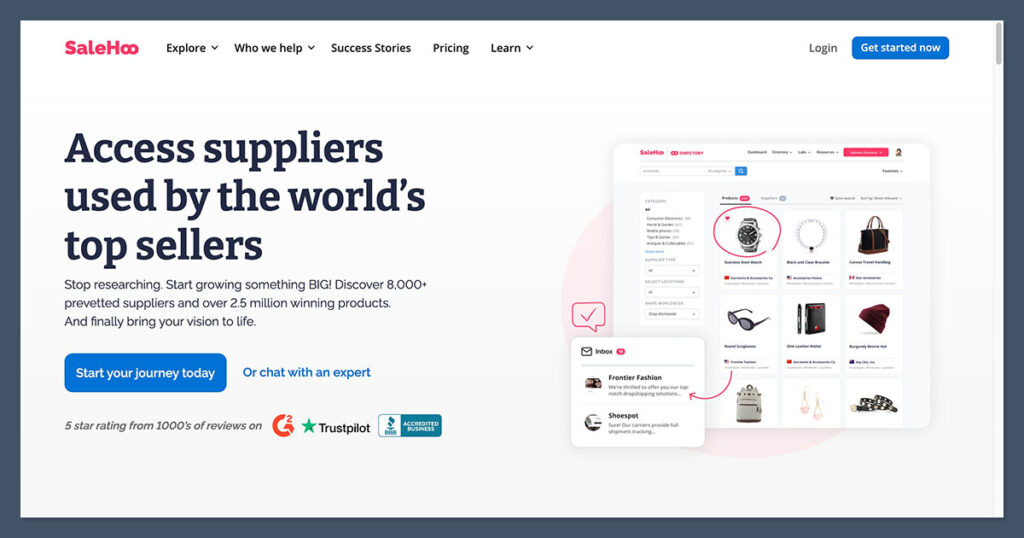
SaleHoo has been running since 2005 and remains the most complete paid directory we’ve used. It lists around 8,000 hand-checked suppliers and 2.5 million products, with filters for supplier type, shipping destination, and category, so you can narrow a search down to wholesalers who actually ship to your market.
The important thing to flag is that SaleHoo’s pricing has changed. The old $67 per year membership that most articles still quote no longer exists. The current structure is a Starter plan at $9 per month billed annually, a Pro plan at $49 per month billed annually, and one-time lifetime options starting at $299. Starter caps you at 100 supplier contacts per month and 200 product imports, while Pro removes the contact limit and adds concierge supplier research.
Beyond the directory itself, membership includes market research tooling that tracks sell-through rates and competition across roughly 1.6 million products, a Shopify course, and access to a long-running member community. For sellers who would otherwise pay separately for a research tool, that bundling is where the value sits.
What we like
- Suppliers are manually checked rather than accepted on payment alone
- Genuine global coverage, including US and UK suppliers with domestic shipping times
- Research tools bundled in, which offsets the subscription for many sellers
- 60 day refund window is longer than most of the paid competition
- Works with any platform, not just Shopify, via CSV export
What to watch
- The entry price is now higher than the widely quoted $67 per year figure
- Starter’s 100 contacts per month limit is restrictive if you are sourcing across several niches
- You still negotiate terms and minimums with each supplier yourself
- Directory size is smaller than open marketplaces like Alibaba
2. Worldwide Brands (Global)
- Best for: Sellers who prefer a single payment over a subscription
- Coverage: Heavily US-weighted, with international suppliers included
- Cost: $299 one-time for lifetime access, with periodic promotional pricing
- Guarantee: 60 day money-back guarantee
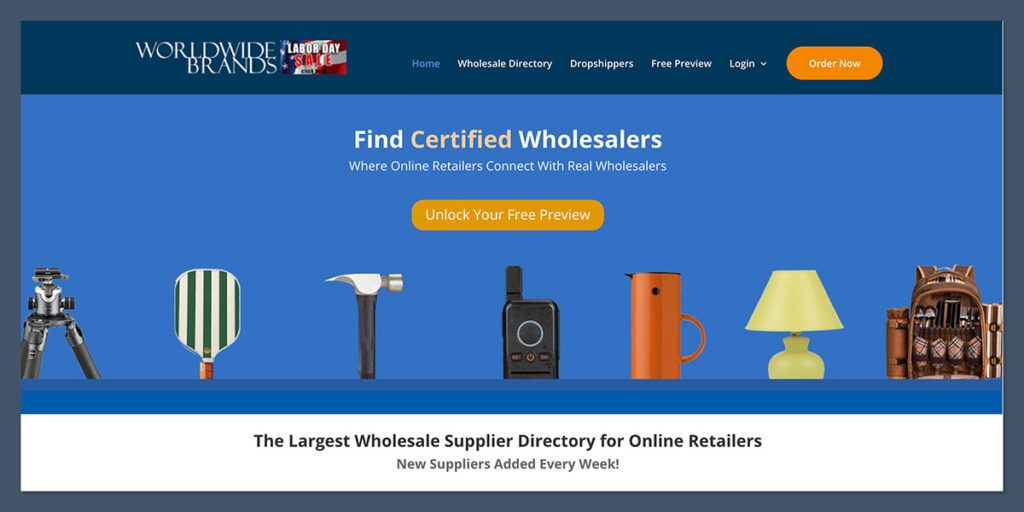
Worldwide Brands launched in 1999 and is the oldest paid directory still operating at scale. Its differentiator is the certification process: the company only lists suppliers it has verified as genuine supply-chain wholesalers, which is aimed at filtering out middlemen who buy from other wholesalers and add a markup before selling to you.
The catalogue runs to more than 16 million products from over 8,000 certified suppliers, and the research team adds new suppliers weekly. If you cannot find a supplier for a particular product, members can submit a request and the research team will attempt to track down the authorised wholesaler.
The pricing model is the main reason to choose it over SaleHoo. You pay $299 once and keep access permanently. Over five years that works out cheaper than most annual subscriptions, though the upfront cost is a real barrier if you are testing whether ecommerce is for you at all.
What we like
- One payment, no renewals, no upsell to a higher tier for directory access
- Certification process is stricter than most competitors
- Strong pool of US suppliers, which matters for domestic shipping times
- Product request service if a category is not covered
What to watch
- $299 upfront is the highest entry cost on this list
- The interface feels dated next to newer platforms
- No order management, inventory sync, or selling tools of any kind
- International coverage is thinner than the marketing suggests
3. Wholesale Central (US)
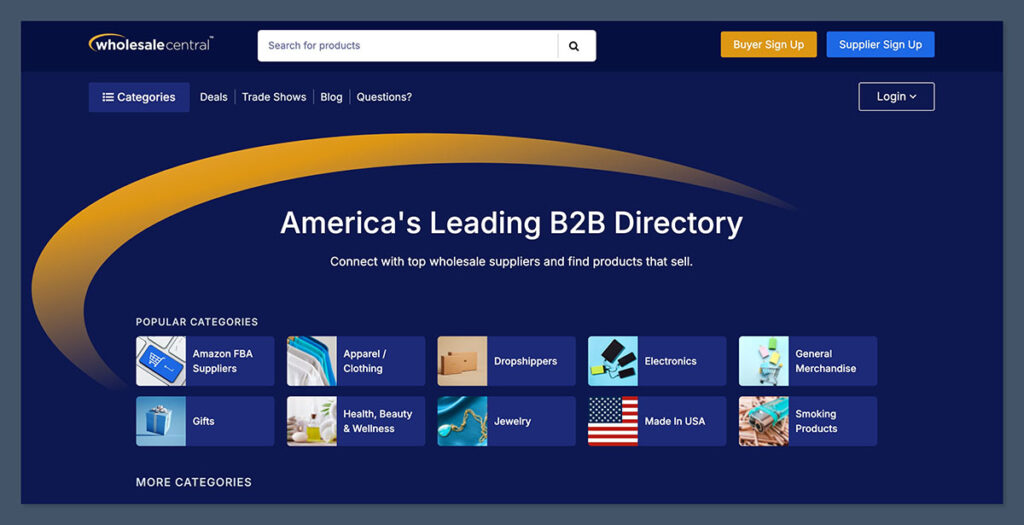
- Best for: Free US supplier discovery with no account required
- Coverage: United States
- Cost: Free
- Access: No registration needed to browse or contact suppliers
Wholesale Central has been running since 1997, which makes it the longest-serving free B2B directory in the US market. It screens the suppliers it lists, organises them across a wide set of categories including apparel, electronics, health and beauty, closeouts, and Amazon FBA suppliers, and lets you search without creating an account.
It is a directory in the strictest sense. There is no checkout, no order tracking, and no messaging layer that sits between you and the supplier. You find a company, you get their details, and you contact them yourself. For experienced buyers that is a feature rather than a limitation, because you keep the relationship and there is no platform commission built into your cost price.
The site also runs a Special Deals section for promotional and closeout inventory, and a trade show calendar that is genuinely useful if you want to meet suppliers in person before committing to volume.
What we like
- Completely free with no paywall or membership tier
- No signup barrier, so you can assess the supplier pool before investing time
- Broad category coverage, including closeouts and dollar store lines
- Trade show listings help you verify suppliers face to face
What to watch
- Vetting depth varies by listing, so you still need to do your own checks
- The interface is basic compared to newer wholesale platforms
- No buyer protection, escrow, or dispute process of any kind
- US focused, so limited value if you are sourcing for a UK or EU store
4. Faire (US, UK, EU)
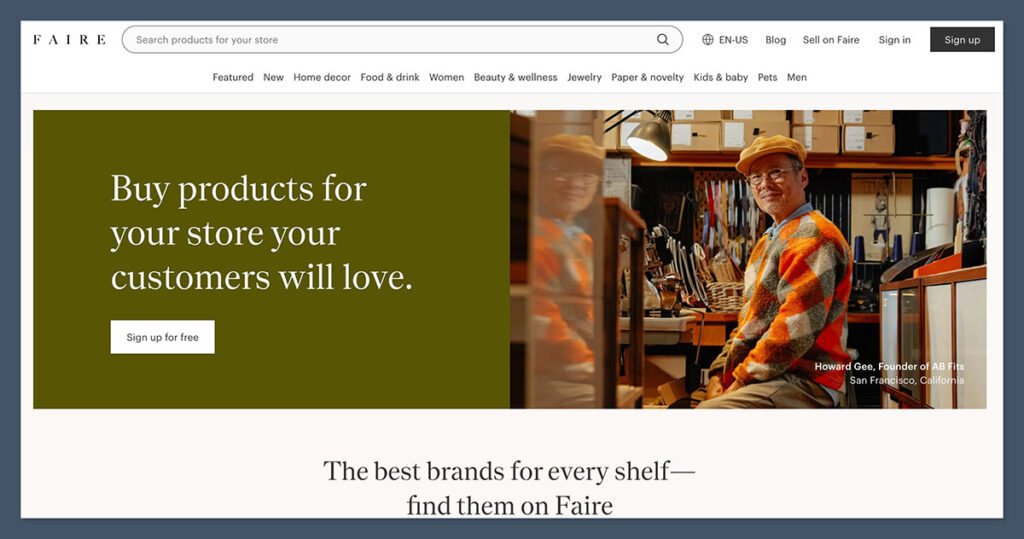
- Best for: Boutiques, gift shops, and independent retailers buying branded goods
- Coverage: North America and Europe
- Cost: Free for verified retailers
- Terms: Net 60 payment terms for eligible buyers, free returns on opening orders
Faire is not a traditional directory, and that is exactly why it belongs on this list. Rather than handing you contact details, it functions as a full wholesale marketplace where you browse over 100,000 independent brands, place orders, and pay through the platform. Shopify made it the recommended wholesale marketplace for its merchants after taking a stake in the company.
Two features make it genuinely useful for small retailers. Eligible buyers get net 60 payment terms, meaning you can stock a shelf and pay for it two months later. And opening orders from a new brand come with free returns, so testing an unfamiliar line does not leave you with dead stock. Together these remove the two risks that usually stop independent shops trying new products.
Access is restricted. Faire verifies that you are a genuine retail business, which typically means providing a resale certificate or tax ID. It is not a route to consumer-priced bulk buying, and it is the wrong platform if you want generic unbranded goods to private label.
What we like
- Free for retailers with no membership or subscription cost
- Net 60 terms materially improve cash flow for small shops
- Free returns on first orders remove the risk of testing new brands
- Consolidated ordering across many brands in one checkout
- Largest network of independent brands of anything on this list
What to watch
- Requires business verification, so it is closed to hobbyists and early testers
- Shipping costs stack up when a cart spans multiple brands
- Brand-side commission is priced into wholesale rates, so unit costs sit above factory direct
- Popular categories such as candles and jewelry are heavily saturated
5. Alibaba (China)
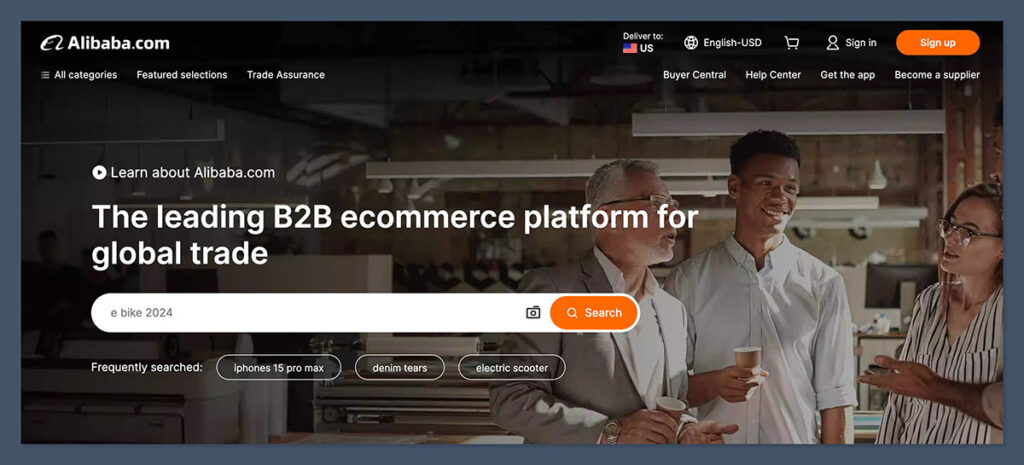
- Best for: Private label, custom manufacturing, and bulk imports
- Coverage: Primarily China, with growing coverage elsewhere
- Cost: Free to browse and contact suppliers
- Protection: Trade Assurance holds payment until delivery is confirmed
Alibaba is the largest B2B marketplace in the world and the default starting point if you plan to create your own brand. Almost anything you can name is manufactured by someone listed on it, and order volumes run from single samples up to full container loads.
Use the platform’s own signals rather than trusting listings at face value. Trade Assurance protects your payment until you confirm delivery, Verified Supplier and audited factory badges indicate a supplier has passed additional checks, and transaction history on a supplier profile tells you more than any product photo will.
The practical caveats are real. Many listings are trading companies rather than the factory itself, minimum order quantities are higher than domestic wholesalers, and import duties plus freight need to be modelled into your landed cost before you compare prices against a US or UK supplier. Tariff changes in recent years have widened that gap for several categories.
What we like
- Unmatched product range and the lowest unit costs at volume
- Trade Assurance gives a real payment protection mechanism
- Best route to private label and custom OEM production
- Free to use with no membership fee
What to watch
- Supplier quality varies enormously and vetting is on you
- Traders often present themselves as factories
- Long lead times, high minimums, and freight complexity
- Duties and tariffs can erase the price advantage in some categories
6. Global Sources (China and Asia)
- Best for: Electronics, components, and technically specified products
- Coverage: China, Hong Kong, and wider Asia
- Cost: Free to browse and request quotes
- Extra: Runs major sourcing trade shows in Hong Kong
Global Sources is the more curated alternative to Alibaba. It applies stricter supplier vetting and focuses on export-ready manufacturers, which makes it the better choice when product specifications matter and you cannot afford a supplier who does not understand certification requirements.
Its electronics coverage is the strongest of any platform here. If you are sourcing consumer tech, components, or anything requiring compliance documentation for your market, the supplier pool is more capable than a general marketplace search will return.
The company also runs long-established trade shows in Hong Kong, which bridges online discovery and in-person verification. For anyone planning to place substantial orders, meeting a shortlisted supplier at a show is one of the cheapest forms of due diligence available.
What we like
- Tighter supplier vetting than open marketplaces
- Best-in-class for electronics and technical goods
- Free to search and request quotes
- Trade shows let you verify suppliers in person
What to watch
- Smaller catalogue than Alibaba across general consumer goods
- Geared toward larger orders, so minimums can be steep
- Less useful for low-volume dropshipping or ready stock
7. Made-in-China (China)
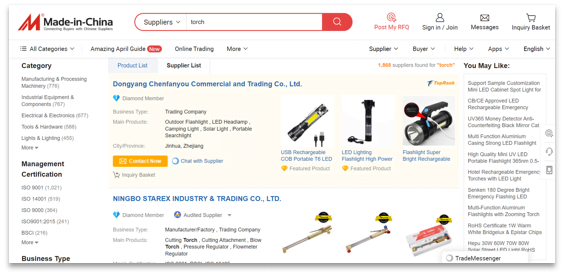
- Best for: OEM production, industrial goods, and factory-direct partnerships
- Coverage: China
- Cost: Free to browse and post buying requests
- Established: 1996
Made-in-China has been operating since 1996 and leans further toward manufacturing than retail-ready inventory. Its strength is in industrial products, machinery, components, and OEM work where you need a factory rather than a distributor.
The buying request feature is the most efficient way to use it. Rather than messaging suppliers one at a time, you post a specification and let relevant manufacturers come to you with quotes, which compresses a week of outreach into a couple of days.
It is a poor fit if you want small quantities of ready stock consumer goods. Product variety across fast-moving retail categories is narrower than Alibaba, minimums tend to be higher, and response times depend heavily on how busy the factory is.
What we like
- Genuine factory access rather than layers of trading companies
- Buying requests generate competing quotes quickly
- Strong in industrial and technical categories
- Free to use with no buyer membership
What to watch
- Not built for low minimum orders or ready stock
- Narrower consumer goods range than Alibaba
- Response times vary widely between suppliers
8. eSources (UK)
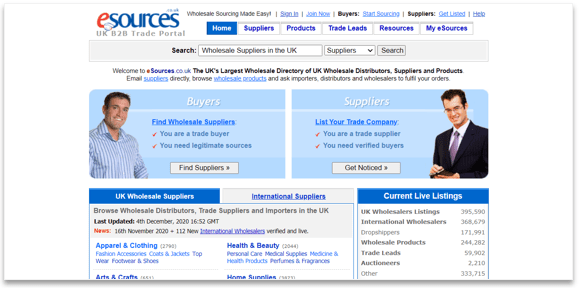
- Best for: Depth of UK and international wholesale listings
- Coverage: UK primary, with international suppliers
- Cost: Free basic buyer account, premium upgrade from around £20 per month
- Established: 2005
eSources is the largest UK-based directory by listing volume, with more than 150,000 verified wholesalers and dropshippers according to the company’s own figures. It covers UK suppliers alongside a substantial international pool, and every listing includes supplier details, main product lines, and business policies.
The free account gets you further than most freemium directories. You can contact premium suppliers, view their full contact details, and post buy requests without paying. The upgrade unlocks access to basic supplier listings, product pricing, and the ability to broadcast a buy request to every relevant supplier at once.
Be aware that the premium tier is bundled with a lot of extras, including a hosted ecommerce website and training courses. Judge it on the directory access alone, because the peripheral features are dated and are not a reason to subscribe.
What we like
- Largest verified UK supplier database of anything on this list
- Free tier is genuinely usable rather than a teaser
- Buy request broadcasting saves days of manual outreach
- Listings include business policies, not just contact details
What to watch
- Pricing is not shown clearly until you begin the signup process
- Bundled website and course extras feel padded and outdated
- Interface is functional rather than modern
- Listing volume does not always equal listing quality
9. The Wholesaler UK (UK)
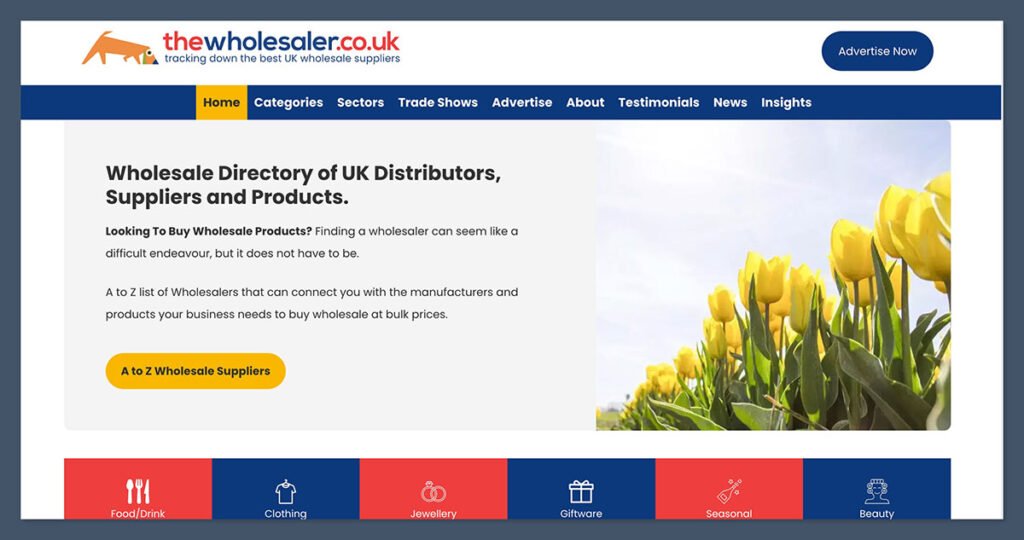
- Best for: Free UK sourcing from suppliers holding stock domestically
- Coverage: United Kingdom
- Cost: Free to buyers, no account required
- Established: 1999
The Wholesaler UK was one of the first web-based wholesale directories in Britain and has run continuously since 1999. Its listing policy is what makes it valuable: it only links to genuine wholesale suppliers who hold stock in the UK, supply in quantities suitable for an independent retailer, and have provided verifiable contact details.
That third criterion matters more than it sounds. A great deal of UK wholesale search traffic ends up on listings for overseas traders with no domestic stock, which means long lead times and customs headaches for a shop that needs to restock in days rather than weeks.
Categories are extensive and browsable from an A to Z index, covering everything from giftware and jewellery to food and drink, fancy dress, and pound lines. The site also maintains a UK trade show calendar.
What we like
- Free with no registration wall
- Suppliers must hold UK stock, which rules out overseas dropshippers
- Minimum quantities suited to independent retailers rather than chains
- Deep category index that is quick to browse
What to watch
- Hundreds rather than thousands of suppliers
- Listings are advertiser-funded, so coverage skews to companies who pay to appear
- No product search, only category browsing
- UK only, with no value for US or EU sourcing
10. TopTenWholesale (US)
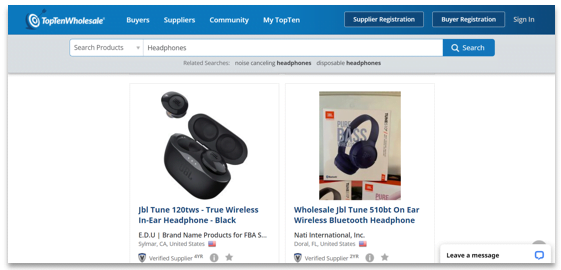
- Best for: Closeouts, liquidation, and general merchandise
- Coverage: US primary, with international suppliers
- Cost: Free to browse and contact suppliers
- Established: 2005
TopTenWholesale operates as a vertical search engine for wholesale rather than a static list. Owned by JP Communications, which also runs Manufacturer.com, it has been live since 2005 and serves retailers, flea market sellers, eBay and Amazon sellers, and chain buyers alike.
Its clearest advantage is in closeouts and liquidation. Several of the largest liquidation suppliers in the US market list here, and the platform maintains editorial coverage of trade events such as ASD Market Week, which is where a lot of that inventory actually changes hands.
The Supplier Pass badge indicates a supplier has been through additional authentication, and the product request feature lets you describe what you need and have suppliers respond. Note that the platform is free to browse but suppliers can pay for premium placement, so the top of a category page is not a ranking of quality.
What we like
- Free to browse with no membership requirement
- Strong closeout and liquidation supplier pool
- Supplier Pass verification badge helps separate authenticated listings
- Product request feature works well for reverse sourcing
What to watch
- Paid placement influences what appears first
- Smaller supplier count than the leading paid directories
- Heavy advertising presence throughout the site
- Quality varies significantly across categories
11. Ankorstore (Europe and UK)
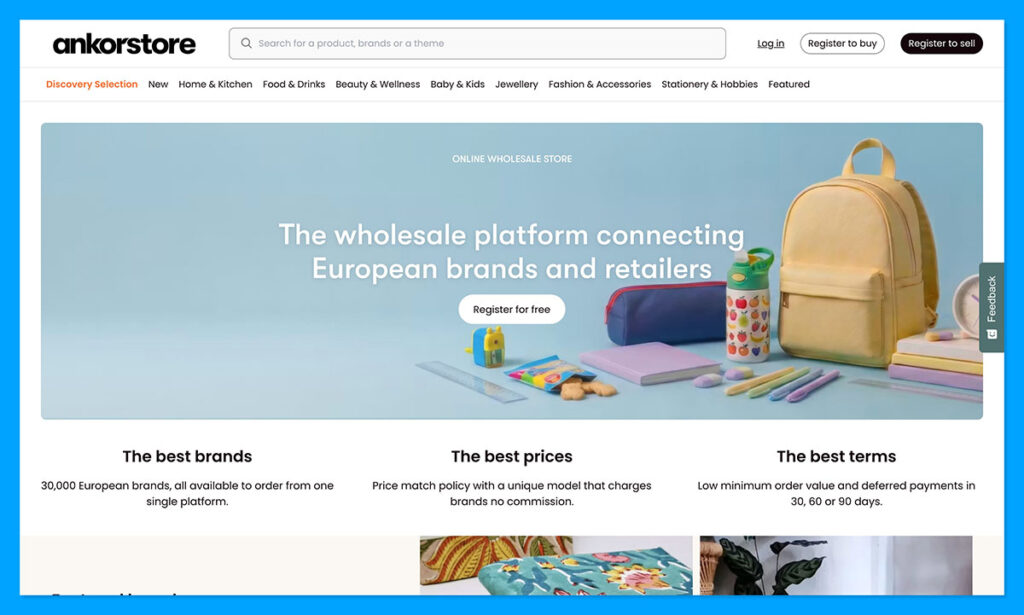
- Best for: European independent retailers sourcing lifestyle and home goods
- Coverage: 25 plus European countries including the UK
- Cost: Free for verified retailers
- Terms: Net 60 payment terms, free shipping above an order threshold
Ankorstore is the European equivalent of Faire, founded in Paris in 2019 and now connecting more than 30,000 brands with over 300,000 verified independent retailers. If you run a shop in the UK or continental Europe, it will usually surface more relevant brands than a US-centric platform will.
Like Faire, it offers net 60 terms and free shipping once you clear an order threshold, which is roughly €300 in most markets. Categories skew toward home, lifestyle, beauty, food and drink, kids, and stationery, so it suits gift shops, delis, and boutiques far better than it suits electronics or general merchandise resellers.
Access is limited to verified retail businesses, and it explicitly excludes buyers who intend to resell on Amazon or comparable marketplaces. That restriction is worth checking before you invest time in an application.

What we like
- Free to join for verified retailers with no subscription
- Best European brand coverage of any platform here
- Net 60 terms and free shipping above threshold
- Consolidated multi-brand ordering in one place
What to watch
- Not open to Amazon or marketplace resellers
- Extra shipping charges apply to some long-distance orders
- Category mix is narrow if you sell outside lifestyle and home
- Cross-border customs handling falls to you initially
12. Clever Wholesale (US and Australia)
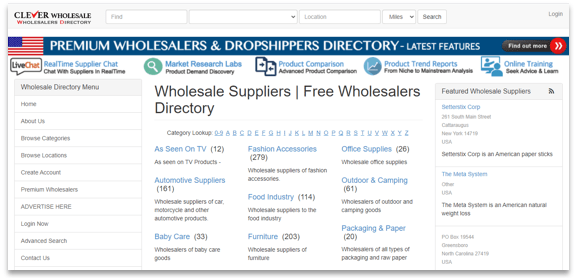
- Best for: Quick, no-friction browsing of US wholesalers by state
- Coverage: United States, plus a separate Australian directory
- Cost: Free for buyers
- Size: Over 1,500 verified companies across 50 plus categories
Clever Wholesale is the smallest directory on this list, but it has been rebuilt and is actively maintained, which is more than can be said for several of its free competitors. It lists over 1,500 verified US wholesale companies across more than 50 product categories and all 50 states.
The state-level browsing is the standout feature. If you want a supplier within driving distance, or you want to minimise domestic shipping time and cost, being able to filter by location is more useful than a bigger database with no geographic filter.
Every listing carries full contact details, and you can either contact suppliers directly or send an enquiry through the platform. There are no paywalls, no membership tiers, and no charge to view contact information.
What we like
- Genuinely free with no gated contact details
- Browse by US state, which no other free directory here offers
- Actively maintained with a current supplier base
- Separate Australian directory for AU-based sellers
What to watch
- Much smaller supplier pool than the paid alternatives
- No product-level search, only supplier listings
- Limited coverage in specialist and technical categories
Other platforms worth knowing
These did not make the main list but are worth a look depending on what you sell:
- Creoate connects UK and European independent retailers with around 6,500 independent brands, with minimum orders starting at £75 and 60 day returns on unsold stock. A reasonable alternative to Ankorstore for smaller shops.
- DHgate is the low-minimum alternative to Alibaba, useful for testing demand on small quantities before committing to a bulk order.
- 1688.com is Alibaba’s domestic Chinese platform and offers factory-direct pricing without export markup, but the site is in Mandarin and normally requires a sourcing agent.
- Orderchamp is the Amsterdam-based competitor to Ankorstore, with stronger coverage in the Benelux and DACH regions.
- Europages and Kompass offer huge European industrial listings but almost no verification or workflow on top of the listing itself.
Free vs paid wholesale directories
The honest answer is that the gap has narrowed considerably. Free directories used to be thin and poorly maintained while paid ones did the vetting. Today, several free options are well maintained, and marketplaces like Faire and Ankorstore give retailers payment terms that no paid directory can match.
| Factor | Free directories | Paid directories |
|---|---|---|
| Supplier vetting | Varies, often minimal | Consistent verification process |
| Who pays to be listed | Suppliers pay listing fees | Usually no supplier listing fees |
| Database size | Hundreds to a few thousand | Thousands of vetted suppliers |
| Research tools | Rarely included | Often bundled in |
| Support | Little to none | Email, chat, or community |
| Best use | Starting point and cross-checking | Serious sourcing at scale |
A practical approach for most sellers: start with the free directories to map out who exists in your niche, then pay for a directory only once you know free listings are not producing suppliers who meet your requirements. If you are already trading and your bottleneck is finding suppliers nobody else has found, that is when a paid membership earns its money.
Why this is worth getting right
Your supplier determines your margin, your delivery times, and how often you deal with refunds. Switching supplier after you have built listings, run ads, and acquired customers is far more expensive than spending an extra week on due diligence up front. Treat directory research as a business decision, not an admin task.
If you are still setting up your storefront, you can start a Shopify trial here and have somewhere to list products before your first order arrives.
How to choose the right directory for your business
Match the directory to your sourcing region
This is the single biggest filter. A US seller using a UK directory will waste weeks on suppliers who cannot ship economically. Wholesale Central, Worldwide Brands, TopTenWholesale, and Clever Wholesale for the US. The Wholesaler UK and eSources for Britain. Ankorstore and Creoate for Europe. Alibaba, Global Sources, and Made-in-China for Asia. SaleHoo spans all of them.
Decide whether you want a list or a marketplace
Directories give you contact details and leave you to negotiate. Marketplaces handle discovery, payment, and terms, but build a commission into your unit cost. If you are buying branded goods for a shop, a marketplace is usually the better trade. If you are building your own brand or need the lowest possible cost price, use a directory and trade direct.
Check your order volume against supplier minimums
Directories full of container-load manufacturers are useless if you want 50 units. Faire, Ankorstore, Creoate, and DHgate work at low volumes. Alibaba, Global Sources, and Made-in-China increasingly do not.
Factor in landed cost, not list price
A supplier quoting a lower unit price overseas can easily end up more expensive once freight, duties, and longer lead times are included. Model total landed cost before comparing a domestic supplier against an overseas one.
How to vet a supplier before you place an order
No directory removes the need for your own checks. Whichever platform you use, run through this before sending money:
- Confirm the business is registered. Check the company number against your national register. In the US that is the state registry, in the UK it is Companies House.
- Establish whether they are the manufacturer or a middleman. Ask directly. Ask what else they produce on the same line. Vague answers usually mean a trading company.
- Order a sample before anything else. Always. The cost of a sample is trivial next to the cost of a bad bulk order.
- Look for reviews off the platform. Search the company name on Trustpilot, industry forums, and Google, not just the ratings displayed on the directory itself.
- Test their responsiveness. How quickly and clearly they answer pre-sale questions is the best available predictor of how they will handle a problem later.
- Ask about their returns and defect policy in writing. Get it in an email before you order, not after a shipment arrives damaged.
- Use payment protection where it exists. Trade Assurance on Alibaba, or a credit card rather than a bank transfer where you have the option.
- Start small and scale. Place a modest first order even if the price per unit is worse. Prove the relationship works before you commit capital.
Frequently asked questions
What is a wholesale directory?
A wholesale directory is a database that connects business buyers with wholesalers, distributors, and manufacturers. You search by product or browse by category, and the directory provides supplier details so you can trade with them directly. Some directories now operate as full marketplaces where you order and pay on the platform rather than contacting the supplier separately.
What is the best free wholesale directory?
Wholesale Central is the strongest free option for US sourcing, and The Wholesaler UK is the equivalent for British retailers. Both are free to browse without an account. For sourcing from China, Alibaba and Global Sources are free to use and cover far more suppliers than any paid Western directory. Faire is also free for verified retailers, though it works as a marketplace rather than a directory.
What is the best paid wholesale directory?
SaleHoo is the best paid directory overall, with around 8,000 vetted suppliers, global coverage, and bundled product research tools. Worldwide Brands is the better choice if you prefer a single payment, at $299 for lifetime access with no renewals. Which one suits you comes down to whether you would rather pay a subscription or a larger amount once.
Is SaleHoo still $67 per year?
No. That pricing has been retired. SaleHoo now runs a Starter plan at $9 per month billed annually and a Pro plan at $49 per month billed annually, with one-time lifetime access starting at $299. A lot of articles still quote the old figure, so check the pricing page before committing.
Do I need a business licence to use a wholesale directory?
The directory itself will usually let you browse without one, but most legitimate wholesalers will ask for a business registration, a tax ID or EIN, and a resale certificate before opening a trade account. Marketplaces like Faire and Ankorstore verify your retail status before granting access. Get your paperwork in order before you start contacting suppliers.
Are paid wholesale directories worth it?
They are worth it if your bottleneck is genuinely supplier discovery rather than sales. A paid directory buys you vetting and access to suppliers who do not advertise publicly, which saves time and reduces scam exposure. If you have not yet validated that anyone wants your product, that money is better spent elsewhere. Start free, upgrade when free options stop producing results.
What is the difference between a wholesale directory and a wholesale marketplace?
A directory gives you supplier contact details and steps out of the transaction, so you negotiate prices, minimums, and payment terms yourself and keep the full relationship. A marketplace hosts the transaction, handles payment and sometimes credit terms, and takes a commission that is priced into what you pay. Directories generally give lower unit costs, marketplaces give convenience and buyer protection.
Can I use a wholesale directory for dropshipping?
Yes, though you need to filter for suppliers who explicitly offer dropshipping, since most wholesalers require you to buy stock upfront. SaleHoo, eSources, and Wholesale Central all flag dropship suppliers specifically. If dropshipping is your main model, our guide to the best dropshipping directories is a better starting point than this one.
How do I find more wholesale suppliers?
Beyond directories, trade shows remain the most efficient way to meet a lot of suppliers quickly and verify them in person. You can also browse our regional guides to wholesale suppliers in the US, the UK, and China, or work through our list of the best wholesale websites.
Final verdict
There is no single best wholesale directory, because the right answer depends on where you are sourcing from and how you buy. What we can say confidently is which one to start with in each situation.
If you want one paid membership that covers the most ground, choose SaleHoo. The vetting is real, the coverage is global, and the bundled research tools justify the subscription for most sellers. If you would rather pay once, Worldwide Brands at $299 works out cheaper over a few years.
If you are not paying anything, start with Wholesale Central in the US or The Wholesaler UK in Britain, then use Alibaba or Global Sources for anything manufactured in Asia. If you run a physical shop or boutique, Faire and Ankorstore will serve you better than any traditional directory, mostly because of the net 60 terms.
Whichever you pick, the directory only gets you to the door. Sample the product, verify the company, and start with a small order. That discipline matters more than which platform you found the supplier on.