Disclosure: We may earn a commission or fee from some of the links in our content. However, this does not affect our recommendations. Learn more.
DropMagic is an AI store builder that turns a single product link into a complete, individually branded Shopify store, generating the layout, the copy, and the colour and typography system in one pass.
In this DropMagic review, I’ll look at its pricing, the stores it actually designs, and where the AI still needs a human, so you can see whether it’s worth $79 a month for your first store.
Key Takeaways
- Best capability: it builds a full five-page store (home, product, About, FAQ and legal) with its own palette and typography per store, not a shared theme
- Price: one paid plan at $79/month, plus a free plan that builds unlimited stores but cannot publish them to Shopify
- Who it suits: first-time dropshippers and product testers who have a product URL and no designer
- Main limitation: no prompt-based editing, so you fix things section by section, where GodMode AI and PagePilot AI lean harder on an editor
- Extra costs: you still need your own Shopify plan on top, which puts the real monthly floor near $118
📢 Read about the recent changes I’ve made to this page
I’ve rechecked this review against DropMagic’s Shopify App Store listing and its live pricing in August 2026, refreshing the rating, the review count, the Premium plan inclusions and the free plan’s publishing restriction. I’ve also re-checked every competitor price in the comparison section below.
DropMagic Pros and Cons
Need a quick summary of DropMagic? Here’s what stood out on both sides once I had a store on the screen.
What I Like
- Builds a whole store, not a landing page from one product URL, including the home, product, About, FAQ and legal pages
- Every store gets its own palette, typography and section mix, so two DropMagic stores don’t open looking like the same Dawn theme in different colours
- The AI copy is genuinely usable as a first draft. The weakest thing about it is that it’s generic, not that it’s wrong
- Support is a small named team that answers fast, and app-store reviewers thank Cédric, Fares and the founder by name, not a helpdesk
- The free plan lets you build and preview a real store before you commit a cent
What I Dislike
- The free plan can’t publish, which is the source of nearly every negative review the app has
- One flat monthly tier, with nothing cheaper for someone testing a single product
- No prompt-based editing. Every fix means finding the right section and doing the work by hand
- The section library drops into a fixed five-page structure, so you can’t add page types the AI doesn’t already build
DropMagic holds 4.9 out of 5 from 43 Shopify App Store reviews as of August 2026, and the shape of those reviews matches what I found: strong praise for the output and the people behind it, with the publishing paywall as the one recurring flashpoint.
How Much Does DropMagic Cost?
DropMagic sells one paid plan, and the free one cannot put a store online. That single restriction decides more purchases here than the price does.
- Free ($0): Build and preview unlimited stores. It cannot publish to Shopify.
- Premium ($79/month): Unlimited stores and products, unlimited AI copywriting, the full 57+ section library, a free .store domain, and one-click publishing.
| Plan | Monthly price | AI image credits | Can publish to Shopify? | Best for |
|---|---|---|---|---|
| Free | $0 | 2 per month | No | Judging the real output before you pay |
| Premium | $79 | 30+ per month | Yes | The month you’re actually ready to launch |
The number that decides this purchase isn’t $79, though. DropMagic builds the store and Shopify hosts and sells it, so the subscription sits on top of a Shopify plan rather than replacing one. Shopify Basic runs about $39/month billed monthly, which puts the realistic recurring floor near $118/month before you spend a cent on products, apps or ads.
Is DropMagic Good Value for Money?
- One flat tier means no ladder. Nothing cheaper if you’re testing a single product, nothing bigger if you outgrow it
- The free plan is a real evaluation tool. You see your actual store before paying, which most rivals in this category don’t allow
- You’re buying design and copy you’d otherwise commission once from a freelancer, so the maths turns entirely on how many stores you build
- Against a one-time premium theme, DropMagic costs more from roughly month three onward (more on that in the comparison section)
Author’s Testing Notes
Build on the free plan first and push the store as far as it will go. The free tier exists so you can judge the output before you pay, and the output is the only thing worth judging here. Subscribe in the month you’re genuinely ready to publish, and treat the fee as a launch cost rather than a standing subscription if you’re testing one product. If you run several product tests a month, the flat unlimited-builds pricing is the version of this that makes sense.
Bogdan Rancea, ecomm.design reviewer
Can I get a discount?
Not in any published form. DropMagic bills every 30 days with no annual option and no public discount on its single tier, so budget the full $79.
My Experience With DropMagic
Setup tells you what DropMagic is before you generate anything. It installs from the Shopify App Store and connects to your store during onboarding, so it writes into Shopify rather than replacing it.
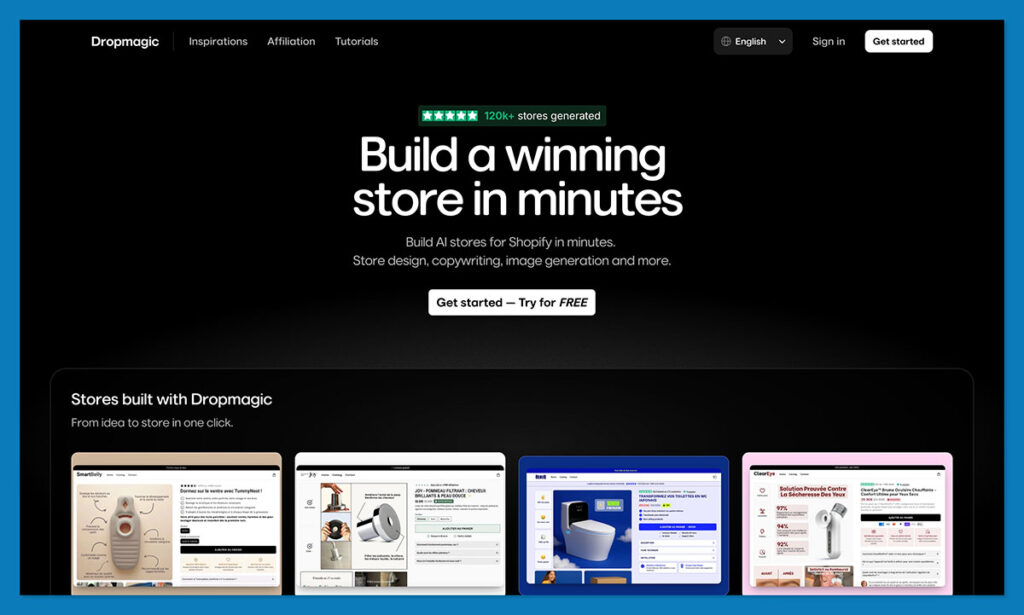
Then comes the only input that really matters. You paste a product URL. That single field replaces the entire brief you would normally write for a designer, and everything the AI produces is inferred from whatever sits behind that link.
How I Imported My First Product
The import step accepts product pages from AliExpress, Amazon and other Shopify stores, pulling the title, the images, the description and the specs straight off the source listing.
That is also the first real limit. A thin AliExpress page with three grainy photos gives the AI thin material to write from. Five minutes spent finding a better source page does more for your store than any setting in the tool. I pasted one AliExpress URL and DropMagic pulled the title, gallery and specs across without any cleanup from me. Source: ecomm.design
What the AI Generated
Generation produces a full five-page store: home, product page, About, FAQ and the legal pages, and it arrives in minutes rather than hours.
What arrives is more coherent than I expected. The homepage opens with a real hero rather than a stock banner, the product page is a long-form sales page built from the section library instead of a bare Shopify template, and the copy reads as though someone wrote it to a persona.
Brace yourself for AI slop and you will not find it. The writing is competent and structurally sound, which makes the real weakness harder to spot rather than easier. This is what landed after a single generation run, with no edits from me at all. Source: ecomm.design
Author’s Testing Notes 📝
Treat the generated store as a strong first draft, not a finished shop. Budget an hour or two to read every line, cut the copy back and replace the hero image. The AI cannot know your margin, your shipping times, or why someone should buy from you instead of from the same AliExpress listing they can find themselves. That is the question a first store has to answer.
Bogdan Rancea, ecomm.design reviewer
Customising the Store
The editor is section-based. You pick sections from the library, reorder them and swap them out, rather than dragging elements freely around a canvas.
Nothing here lets you describe a change in words and have the tool apply it. Every fix means locating the right section, opening it and editing by hand. The library rewards a proper browse, and it is organised loosely enough that finding one specific layout takes trial and error.
Publishing is a single click through to Shopify. It is also the gate, and the moment the subscription stops being optional.
Designing With DropMagic: What the Generated Stores Actually Look Like
Most AI store builders in this category hand you a lightly restyled Dawn or Sense theme, which is why their output shares a silhouette. DropMagic generates a layout, a palette and a type pairing per store, so two DropMagic stores do not open looking like siblings.
However, uniqueness at the theme level is not the same as uniqueness at the page level, and the honest read lives in that gap.
Branding and Colour
The AI infers a look from the product itself. Category, price point and the imagery on the source listing all feed the palette and type pairing it picks, so a supplement listing and a home decor listing do not come back with the same typography.
The results are safe and competent rather than distinctive, the standard a decent freelancer hits on a first pass. For a first store that is the right bar. The palette and type pairing arrived already applied across all five pages, not as options to choose from. Source: ecomm.design
The Section Library
Premium gives you 57 or more conversion-focused sections, with new ones arriving monthly, all dropping into that fixed five-page structure.
The design consequence is plain. Because every store is assembled from the same section shapes, DropMagic stores start to rhyme once you have seen a few: same hero pattern, same trust-badge row, same testimonial block. Unique colours on shared bones. That matters far less on your first store than on your fifth. Browsing the section library took most of my editing time, and better categorisation would help. Source: ecomm.design
🖼️ AI Images
Image generation is the weakest part of the output, and both plans cap how much of it you get. Generated imagery still reads as generated, particularly in lifestyle shots, and shoppers have got good at spotting it.
Spend the credits on backgrounds and section fillers. Use real supplier photography or your own shots for the hero and the product gallery, where people actually look.
📱 Mobile Rendering
DropMagic builds the storefront mobile-first, which matters because a phone is where paid traffic lands.
The merchant side is a different story. A Shopify App Store reviewer flagged in April 2026 that the builder could not be configured or personalised on a tablet, and DropMagic has published nothing since to say that changed. The store renders on a phone. The editor wants a desktop.
Can I edit the design with a prompt? 💻
No. Design changes mean selecting a section and editing it, not describing what you want. If you expect to type “make the hero darker” and have the tool carry it out, this is not the tool.
What DropMagic Actually Builds for You
DropMagic builds the storefront. It does not find your product, hold your inventory, ship anything or optimise the store after launch. Draw that boundary early and you avoid buying the right tool for the wrong job.
AI Copywriting
The AI writes persona-targeted headlines, product descriptions, About-page copy and FAQ answers.
It is strong on structure and rhythm and weak on brand voice. Everything reads correctly, and nothing sounds like a specific person wrote it. Rewrite the hero headline and the first paragraph of the product description in your own words before you send traffic, because those two blocks carry most of the persuasion on the page.
Imports and Integrations
One-click product import works from AliExpress, Amazon and Shopify, and the app connects to AutoDS, DSers, Spocket, Zendrop, Minea and Kaching Bundles.
DropMagic slots into a dropshipping stack you probably already have rather than replacing it. Kaching Bundles is a connection, not a bundled freebie, so you still pay for it separately.
What You Own After You Cancel
Your published store lives on Shopify rather than on DropMagic’s servers, so cancelling does not take it offline. What you lose is the ability to generate new sections, regenerate existing ones, and receive the monthly section drops that come with Premium.
Read DropMagic’s cancellation FAQ before you commit, especially if you plan to subscribe for one month and stop.

| In the box | Not in the box |
|---|---|
| Store generation from a product URL | Hosting and a Shopify plan |
| AI copywriting across all five pages | Product research and supplier sourcing |
| AI image credits | Fulfilment and shipping |
| A per-store branding system | Ad creatives |
| The full section library | Post-launch CRO and A/B testing |
| One-click publishing and a free .store domain | TikTok Shop and other sales channels |
Top Tip 💡
Before you generate anything, pick the cleanest source listing you can find. The AI writes from what the source page gives it, so a well-photographed listing with real specifications produces a noticeably better store than a thin one. It is the most valuable minute you will spend in this tool.
Using DropMagic’s Customer Support
Across the Shopify App Store reviews, the praise is not for “support” as a department. Reviewers thank specific people. Cédric comes up most often, Fares next, and founder Loic Berthelot answers some threads himself.
Here is where you can reach the team:
- In-app chat and email, the route most reviewers describe using
- Tutorials and onboarding guidance inside the product, aimed at people who have never built a store before
- The Shopify App Store review threads, where the team replies publicly and quickly
Unfortunately, a small named team cuts both ways. It is what makes the replies feel human, and it is also what makes response times a function of who happens to be awake. The listing is English-only while a large share of the user base is French and EU-based, so DropMagic does not commit to support in other languages.
That directness shows up in public too. One app-store reviewer who complained that publishing was not free got a short reply from the developer saying the pricing was clear, rather than an offer to help.
How Does DropMagic Compare to Competitors?
What DropMagic does better than anything else I have looked at in this category is hand you a whole store rather than a page, with a design system generated per store instead of a shared theme reskinned in your colours. If what you are buying is design, that is the differentiator, and nothing else here matches it.
If a flat monthly fee does not fit how you work, these are the real alternatives:
- A premium Shopify theme is the cheapest long-run route if you are willing to write your own copy. Most premium themes are a one-time $180 to $350, and the free Dawn theme costs nothing, so a theme pays for itself against a monthly subscription within a few months
- PagePilot AI is better if you only need high-converting product and landing pages rather than a full storefront, starting around $39/month
- GodMode AI is better if you want research baked into the build, with review mining and CRO rules rather than pure generation speed, at $99.90/month for its entry paid tier
- Atlas AI is better if you want a lower monthly entry point, at $39/month on its own pricing page, though its stores share one proprietary theme, so you give up the per-store design system that is DropMagic’s main advantage
- BuildYourStore.ai is better if your constraint is purely budget, since the builder itself is free and your only recurring costs are Shopify and a supplier tool
Which one you pick comes down to what you are actually paying for: design (DropMagic), pages (PagePilot), research (GodMode), a smaller monthly bill (Atlas), or nothing beyond a theme and your own writing time.
How We Test AI Store Builders
We review AI store builders the way a shopper meets them, by looking at the store that comes out the other end. ecomm.design catalogues thousands of live ecommerce designs, so the benchmark is real storefronts, not a feature list.
Our criteria are weighted accordingly:
- Design output (35%). Does the store read as a real brand? Palette, typography, layout coherence and image quality, plus how much variety survives across builds
- Ease of use (20%). How far a beginner gets unaided, and how hard it is to fix the AI’s mistakes
- Editability and control (15%). How much of the output you can change, and how
- Value for money (15%). Total cost to a live selling store, not the sticker price
- Support (10%). Channels, responsiveness, and whether a human answers
- Scope (5%). What is included versus what you still have to buy
Design carries the heaviest weight on purpose: it is the one thing a shopper judges in under a second. This assessment weighs DropMagic’s generated stores against that catalogue, alongside its Shopify App Store listing and its own documentation.
DropMagic Review: Should You Build Your First Store With DropMagic?
DropMagic is the strongest tool I have looked at for turning a product URL into a store that looks like somebody designed it. The per-store branding system is real, and it is the thing rivals built on a shared theme cannot match however good their editors get. If you have a product and no design ability, this closes that gap in an afternoon.
It suits first-time dropshippers who are ready to launch now, and product testers building several stores a month, where unlimited builds at a flat price is genuinely good value. It suits you less if you are pre-revenue and stretching runway. The subscription plus a Shopify plan is a standing bill arriving before a single visitor does, and a one-time premium theme plus your own copy gets one store live for less over any reasonable timeframe. Whichever route you take, plan on rewriting the AI’s headline copy and replacing the hero image, because that part is not optional.
The free plan answers the whole question. Build your store on it, look at the real thing rather than a demo video, and pay only in the month you are ready to publish. That way $79 buys you a launch rather than a subscription you forget to cancel.
DropMagic Review FAQ
Is DropMagic free?
Partly. The free plan builds unlimited stores and lets you preview them, but it cannot publish to Shopify, which requires the $79/month Premium plan. This is the single most common complaint in the app’s reviews, so treat the free plan as an evaluation tool rather than a way to launch for nothing. It is still the right place to start, because it shows you the actual store rather than a demo.
How much does a DropMagic store really cost per month?
Around $118 to start. DropMagic does not host your store, so you also need a Shopify plan from roughly $39/month on top of the subscription. That is before products, apps, a custom domain or any ad spend, all of which arrive fast once you are actually selling. Budget that as your standing cost and treat everything else as variable.
Will my store look like every other DropMagic store?
Not at the theme level. Each build gets its own palette, typography and section mix, so DropMagic stores do not share a silhouette the way Dawn-based builders do. They do share section shapes, so once you have seen several the layouts start to rhyme. Change the hero and swap in your own imagery and most of that disappears.
What happens to my store if I cancel DropMagic?
It stays live. Your published store runs on Shopify rather than on DropMagic, so cancelling the subscription does not take it down. You keep the store and lose the generator: no new sections, no regenerating the ones you have, and no monthly section drops. Confirm the current terms with DropMagic before you cancel if your store still needs edits.
Does DropMagic work with WooCommerce or BigCommerce?
No. DropMagic is Shopify-only and publishes through the Shopify App Store, so a WooCommerce or BigCommerce store cannot use it. If you are still choosing a platform and you want this tool, that decision is made for you.
Do I need design or coding skills to use DropMagic?
No. The AI produces the layout, the palette and the copy, and you edit by selecting sections rather than writing code. What you do need is judgement. The store arrives as a strong first draft, and the parts that persuade a shopper (the headline, the hero image, the first product paragraph) are the parts worth rewriting yourself.